Guerrero Coast · Pacific Mexico

Fish
of La Saladita.

Headland reef, open coast surf zone, and Río Petatlán estuary. Three distinct habitats. 180 species documented in iNaturalist. Roosterfish in the shore break. Moray and surgeonfish on the rocks. Snook in the lagoon mouth.

Fish are systematically underrepresented in iNaturalist and GBIF — underwater photography requires gear most visitors don't bring. The 47 species catalogued here are a floor, not a ceiling.

47 species photographed in these waters

1,436 observations across 180 identified species — the photo field guide.

Field guide
Photo field guide

Species you're likely to see at Saladita

Game fish (what people fish for)

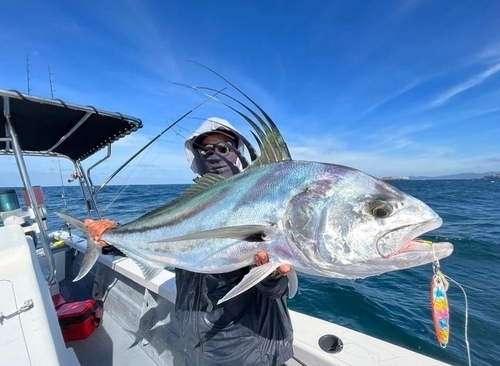
View species detail for Nematistius pectoralis Roosterfish (Nematistius pectoralis) Pez gallo Roosterfish Nematistius pectoralis details → Signature inshore game fish
View species detail for Caranx caninus Pacific Crevalle Jack (Caranx caninus) Jurel toro Pacific Crevalle Jack Caranx caninus details → Hard-fighting, pelagic
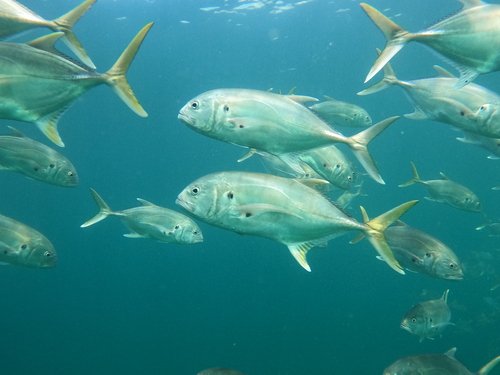
View species detail for Coryphaena hippurus Dolphinfish (Mahi-mahi) (Coryphaena hippurus) Dorado Dolphinfish (Mahi-mahi) Coryphaena hippurus details → Offshore, fast-growing
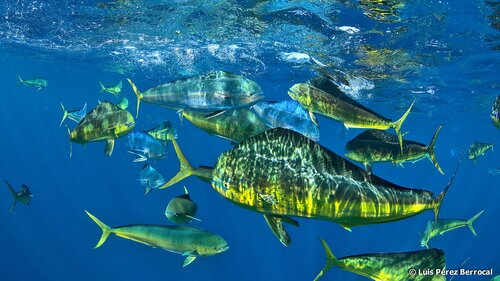
View species detail for Thunnus albacares Yellowfin Tuna (Thunnus albacares) Atún aleta amarilla Yellowfin Tuna Thunnus albacares details → Offshore pelagic
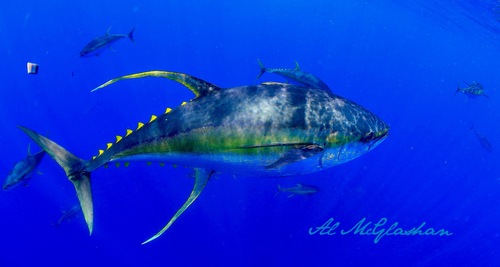
View species detail for Istiophorus platypterus Pacific Sailfish (Istiophorus platypterus) Pez vela Pacific Sailfish Istiophorus platypterus details → Iconic billfish
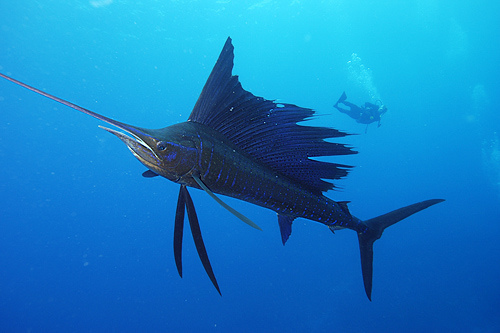
View species detail for Kajikia audax Striped Marlin (Kajikia audax) Marlín rayado Striped Marlin Kajikia audax details → Migratory billfish
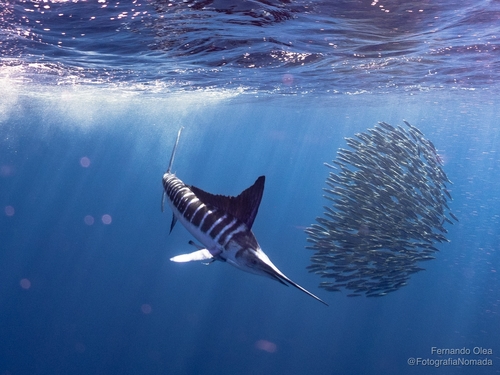
View species detail for Acanthocybium solandri Wahoo (Acanthocybium solandri) Peto Wahoo Acanthocybium solandri details → Fast pelagic predator
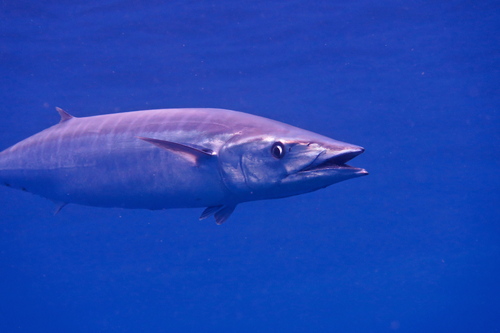
View species detail for Scomberomorus sierra Pacific Sierra (Scomberomorus sierra) Sierra Pacific Sierra Scomberomorus sierra details → Inshore mackerel, seasonal
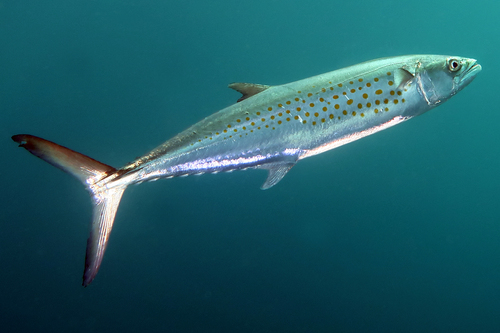
View species detail for Seriola lalandi Yellowtail Amberjack (Seriola lalandi) Jurel de Castilla Yellowtail Amberjack Seriola lalandi details → Inshore/reef edge
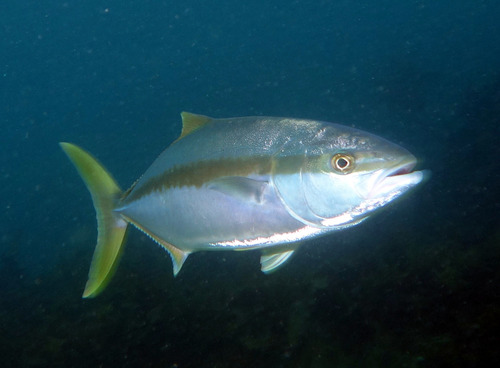
View species detail for Katsuwonus pelamis Skipjack Tuna (Katsuwonus pelamis) Barrilete Skipjack Tuna Katsuwonus pelamis details → Nearshore pelagic, schools
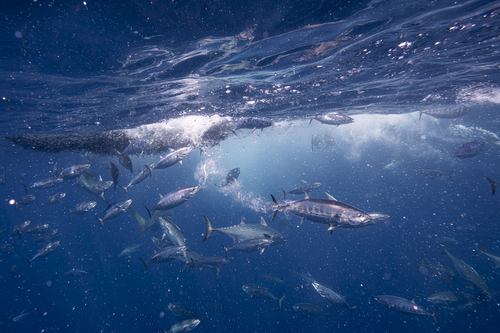
View species detail for Sarda chiliensis Pacific Bonito (Sarda chiliensis) Bonito del Pacífico Pacific Bonito Sarda chiliensis details → Fast-moving schooling tuna relative
Reef & inshore

View species detail for Lutjanus argentiventris Yellow Snapper (Lutjanus argentiventris) Pargo amarillo Yellow Snapper Lutjanus argentiventris details → Reef snapper, common
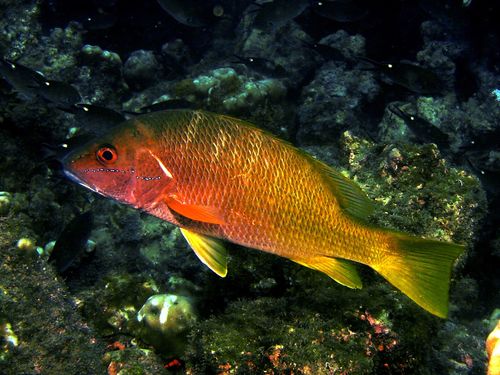
View species detail for Lutjanus colorado Colorado Snapper (Lutjanus colorado) Pargo colorado Colorado Snapper Lutjanus colorado details → Rocky reefs
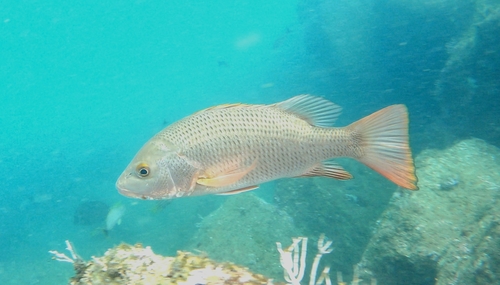
View species detail for Lutjanus peru Pacific Red Snapper (Lutjanus peru) Pargo rojo del Pacífico Pacific Red Snapper Lutjanus peru details → Reef & estuary, good eating
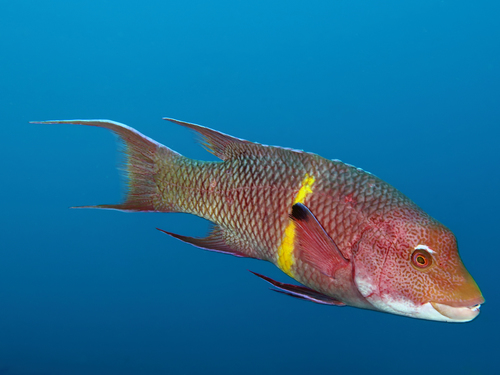
View species detail for Bodianus diplotaenia Mexican Hogfish (Bodianus diplotaenia) Vieja mexicana Mexican Hogfish Bodianus diplotaenia details → Colorful reef wrasse
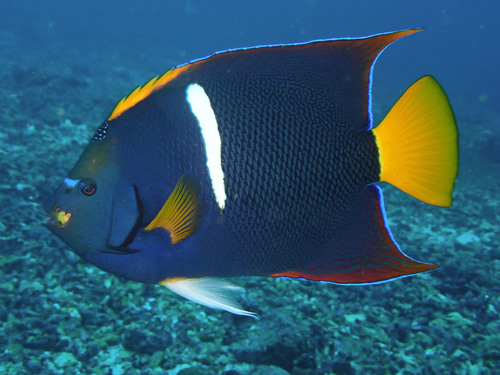
View species detail for Holacanthus passer King Angelfish (Holacanthus passer) Ángel real King Angelfish Holacanthus passer details → Striking reef angelfish
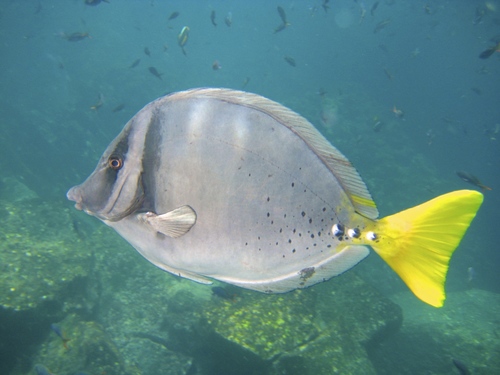
View species detail for Prionurus laticlavius Razor Surgeonfish (Prionurus laticlavius) Cochinito Razor Surgeonfish Prionurus laticlavius details → Reef herbivore, schools
View species detail for Stegastes rectifraenum Cortez Damselfish (Stegastes rectifraenum) Castañeta de Cortés Cortez Damselfish Stegastes rectifraenum details → Tiny, territorial
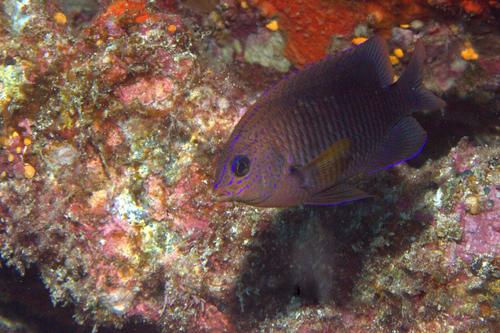
View species detail for Fistularia commersonii Reef Cornetfish (Fistularia commersonii) Pez corneta Reef Cornetfish Fistularia commersonii details → Long, thin, ambush predator
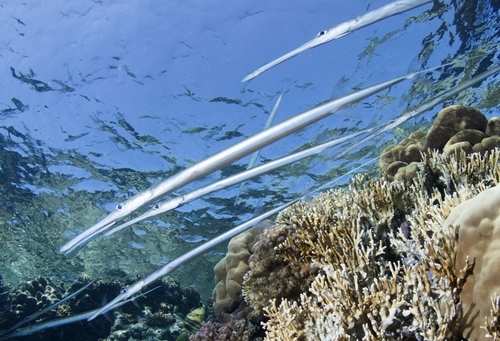
View species detail for Abudefduf troschelii Panamic Sergeant Major (Abudefduf troschelii) Petaca rayada Panamic Sergeant Major Abudefduf troschelii details → Reef damselfish, highly visible
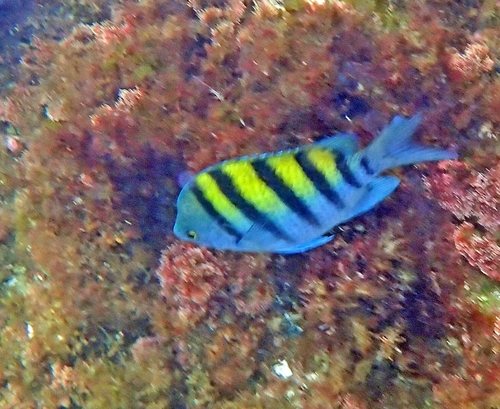
View species detail for Scarus perrico Bumphead Parrotfish (Scarus perrico) Pez loro jorobado Bumphead Parrotfish Scarus perrico details → Large reef grazer, iNat-confirmed
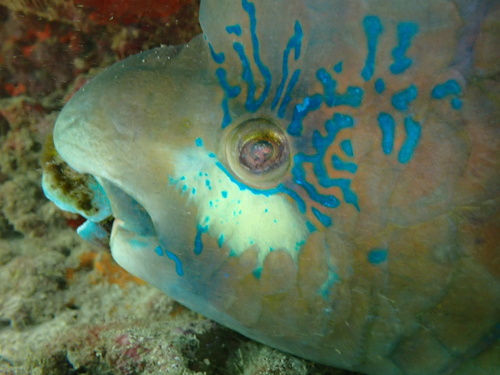
View species detail for Sufflamen verres Orangeside Triggerfish (Sufflamen verres) Cachúa naranja Orangeside Triggerfish Sufflamen verres details → Reef triggerfish, Eastern Pacific
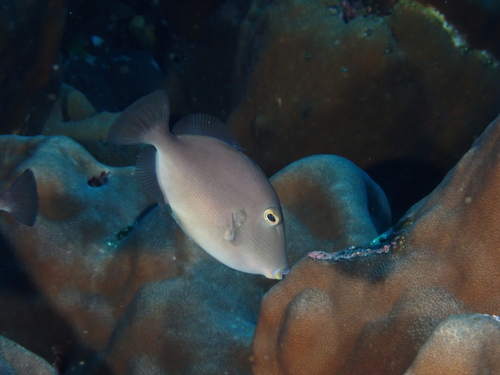
View species detail for Gymnothorax castaneus Chestnut Moray (Gymnothorax castaneus) Morena café Chestnut Moray Gymnothorax castaneus details → Rock crevice, iNat-confirmed
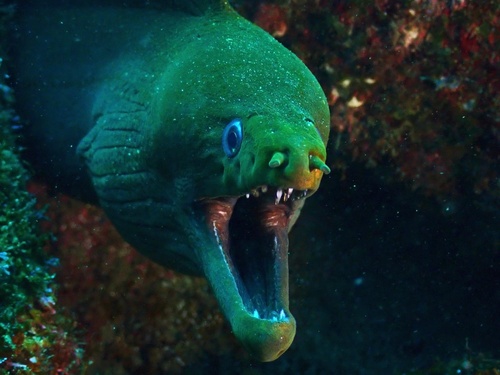
View species detail for Sphoeroides annulatus Bullseye Puffer (Sphoeroides annulatus) Botete diana Bullseye Puffer Sphoeroides annulatus details → Common nearshore, iNat-confirmed
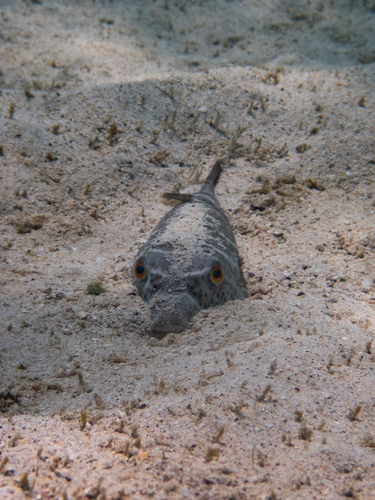
Estero, mangrove & surf zone

View species detail for Centropomus nigrescens Black Snook (Centropomus nigrescens) Robalo prieto Black Snook Centropomus nigrescens details → Estero + surf-zone, predator
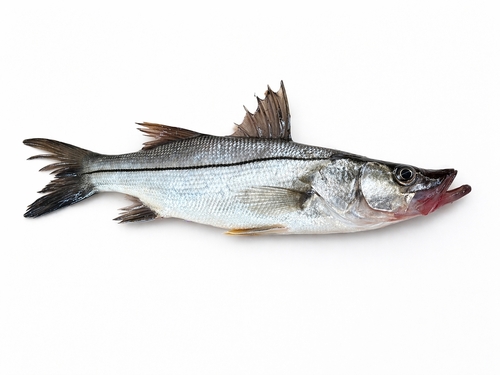
View species detail for Centropomus undecimalis Common Snook (Centropomus undecimalis) Robalo blanco Common Snook Centropomus undecimalis details → Estero, mangrove channels
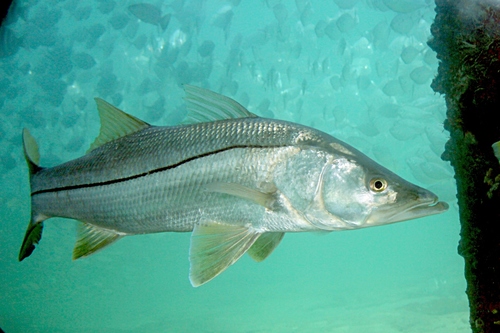
View species detail for Mugil cephalus Flathead Mullet (Mugil cephalus) Lisa Flathead Mullet Mugil cephalus details → Schools in shallows + estero
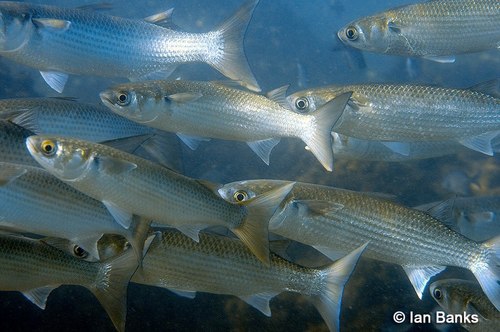
View species detail for Eugerres axillaris Pacific Flagfin Mojarra (Eugerres axillaris) Mojarra del Pacífico Pacific Flagfin Mojarra Eugerres axillaris details → Estero forager
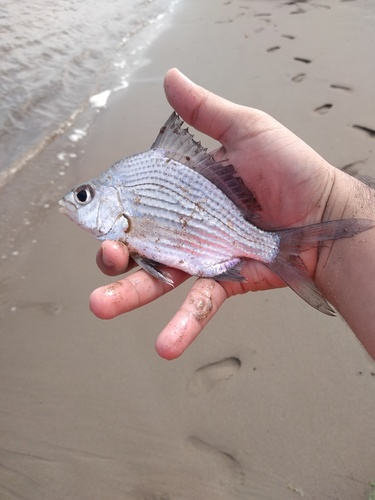
View species detail for Albula vulpes Bonefish (Albula vulpes) Macabí Bonefish Albula vulpes details → Sand flats, prized by anglers
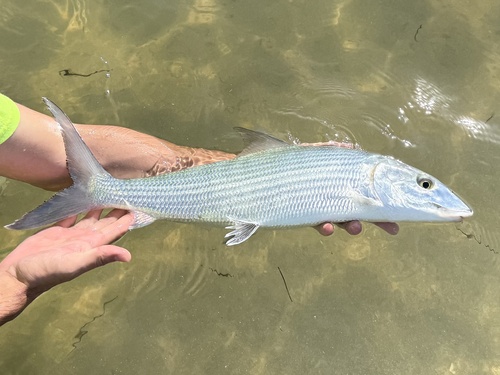
View species detail for Mugil curema White Mullet (Mugil curema) Lisa blanca White Mullet Mugil curema details → Lagoon mouth, beach seine target
View species detail for Selene brevoortii Mexican Lookdown (Selene brevoortii) Jorobado mexicano Mexican Lookdown Selene brevoortii details → Sandy nearshore, bizarre profile
Surf zone & open coast encounters

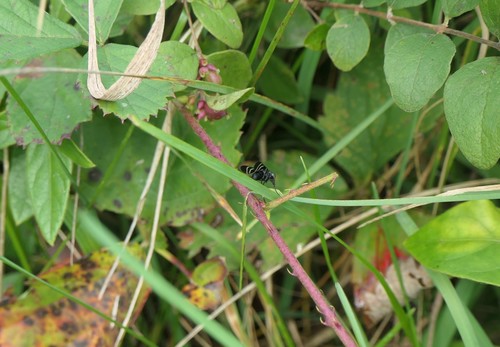
View species detail for Tylosurus crocodilus Houndfish / Needlefish (Tylosurus crocodilus) Marao / agujón Houndfish (Needlefish) Tylosurus crocodilus details → Surface predator, seen at Saladita Jun 2026
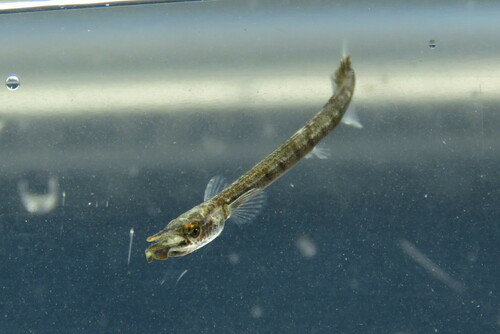
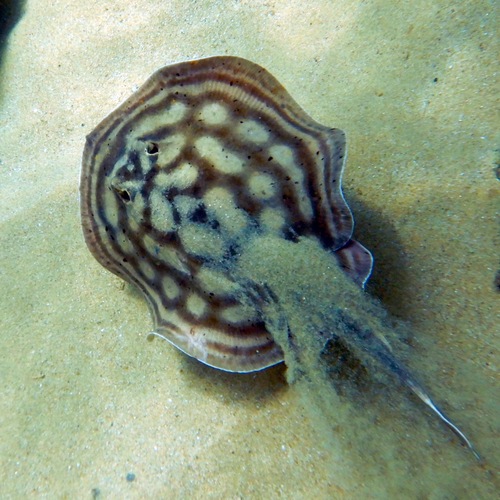
View species detail for Urobatis concentricus Bullseye Round Stingray (Urobatis concentricus) Raya redonda ojo de toro Bullseye Round Stingray Urobatis concentricus details → Sandy bottom hazard — shuffle step
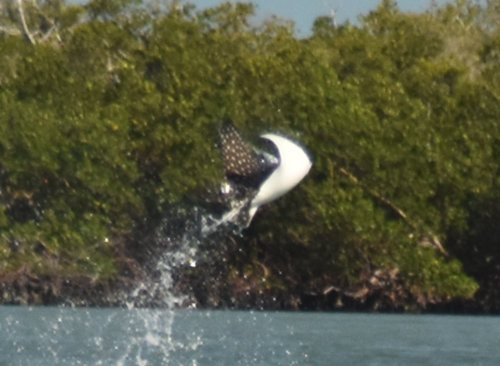
View species detail for Aetobatus laticeps Pacific Eagle Ray (Aetobatus laticeps) Raya águila del Pacífico Pacific Eagle Ray Aetobatus laticeps details → Passes through surf zone, iNat-confirmed
View species detail for Urotrygon aspidura Spiny-tailed Round Stingray (Urotrygon aspidura) Raya cola espinosa Spiny-tailed Round Stingray Urotrygon aspidura details → Sandy bottom, surf zone
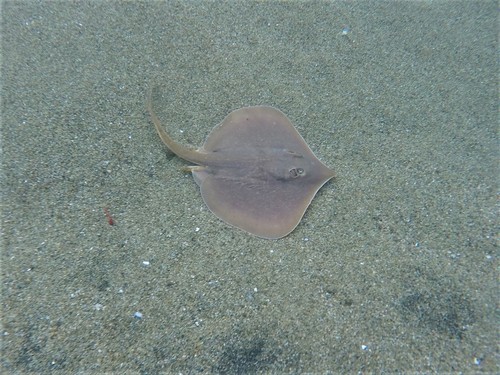
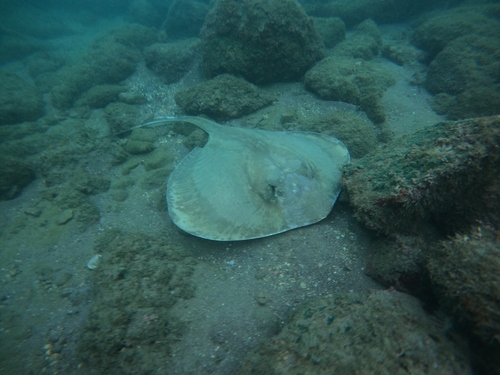
View species detail for Hypanus dipterurus Diamond Stingray (Hypanus dipterurus) Raya diamante Diamond Stingray Hypanus dipterurus details → Sandy bottom, estuary
Photos via iNaturalist (CC-licensed observations from across the Mexican Pacific). Species grouped by where you'll encounter them. Saladita is a fishing village — many of the game fish above are landed daily on local pangas. Estero fish (snook, mojarra, bonefish) move between the lagoon and the surf zone with the tide.
A note on the data

What the record shows, and what it doesn't.

Fish are systematically underrepresented in iNaturalist and GBIF. Anglers don't usually upload their catches. Recreational divers who photograph fish rarely submit to citizen-science databases. GBIF returned zero records for this bounding box on this build date — a database-coverage gap, not an absence of fish. iNaturalist has 1,436 observations and 180 species for the 50 km study area, contributed almost entirely by snorkelers and reef photographers, which means the headland reef is documented and the open coast and estuary are not.

This catalog combines what is documented with regional knowledge from FishBase and WoRMS. Species marked "Regional knowledge" are credibly present based on biogeographic range and local expertise — they just haven't been uploaded to a public database yet.
1,436 iNat observations 50 km radius, all time
180 documented species iNaturalist, species-level
0 GBIF records bounding box, this build
47 species catalogued here iNat + regional knowledge
Headland reef
Open coast
Lagoon & estuary
Pelagic / offshore
Hazards & encounters

What to watch for
in the water.

Most things in the water here are harmless. A few are worth knowing before you paddle out — the stingrays on the sand, the scorpionfish on the rocks, and what floats in on the wind.

View species detail for Tylosurus crocodilus
Bullseye Round Stingray (Urobatis concentricus) on sandy bottom

Stingrays

Urobatis concentricus, Urotrygon aspidura, Hypanus dipterurus Urotrygonidae / Dasyatidae
9+ iNat observations (Urobatis concentricus) Surf zone hazard

Three stingray species confirmed in the 50 km study area. The bullseye round ray (Urobatis concentricus) is the most frequently documented, with 9 iNaturalist research-grade records in the area. Stingrays rest on the sandy bottom in shallow water — the exact zone where surfers walk in and out. The venom spine is on the tail: a ray that feels the pressure of your foot will whip upward.

Shuffle step. Drag your feet instead of lifting and setting them. This disturbs rays before you step on them, giving them time to move. Standard practice at every sandy-bottom point break in Pacific Mexico.

If stung: soak in the hottest water you can tolerate (hot water denatures the protein-based venom). Seek medical care for spine removal if embedded. Not life-threatening to healthy adults, but acutely painful.

View species detail for Tylosurus crocodilus
Houndfish / Needlefish (Tylosurus crocodilus) at surface

Houndfish / Needlefish

Tylosurus crocodilus details → Belonidae
Regional range; observed at Saladita Jun 2026 Open coast surf zone

The largest needlefish in the Eastern Pacific — up to 1.5 m, mostly beak. Seen at the surface on glassy early mornings, hovering in the lineup or cruising the shorebreak. Feeds on small fish, not people. Startled by light (including night surfing with lights) it will leap and can impale; this is rare but documented globally. Daytime encounters are benign — they move away from surfers.

One was observed cruising alongside surfers at Saladita on June 13, 2026 — a glassy, small-wave morning, exactly their preferred feeding window. Range-confirmed for this coast; not yet a formal iNaturalist record for the study area.

Common names: marao, agujón, pez aguja. No records in the 50 km iNat dataset as of this build. If you photograph one here, upload it to iNaturalist — it would be the first local record.

View species detail for Aetobatus laticeps
Pacific Eagle Ray (Aetobatus laticeps) gliding

Pacific Eagle Ray

Aetobatus laticeps details → Aetobatidae
10 iNat observations Open coast + reef

The most frequently documented elasmobranch in the study area, with 10 iNaturalist research-grade records. Unmistakable in the water: wide diamond-shaped wingspan, long whip tail, distinct white spots on dark dorsal surface. Often seen gliding in pairs or small groups through the surf zone and along the rocky point. Feeds on mollusks and crustaceans on the sandy bottom.

Eagle rays do have a venomous tail spine but are not aggressive. Encounters from the lineup are common during certain swells when they follow baitfish into the break.

IUCN status: Vulnerable (global). Also known as Pacific spotted eagle ray. Previously classified as Aetobatus narinari (Atlantic/Indo-Pacific); the Eastern Pacific population is now A. laticeps.

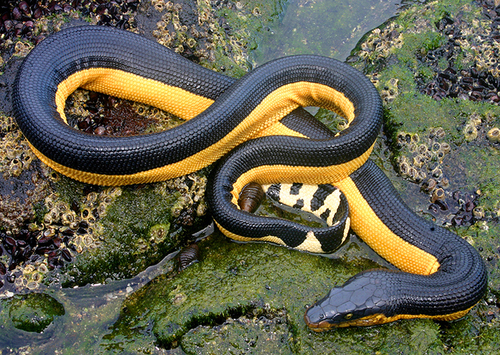
View species detail for Hydrophis platurus
Yellow-bellied Sea Snake (Hydrophis platurus) at the surface

Yellow-bellied Sea Snake

Hydrophis platurus details → Elapidae
13 iNat observations Venomous — do not handle

The only true sea snake in the Eastern Pacific and the most widespread snake on earth. Unmistakable: black above, bright yellow below, with a flattened paddle tail. Lives its whole life at sea, drifting at the surface where currents converge — occasionally washed inshore or onto the beach after storms. 13 iNat records in the study area.

Venomous, but not aggressive. Its venom is potent, but the mouth is small and rear-set and bites on swimmers are exceptionally rare — it does not chase or strike defensively in open water. The real risk is on the sand: a beached snake is still alive and can bite if picked up or stepped on. Never handle one, even a stranded or seemingly dead individual.

If bitten: keep the limb still, apply a pressure-immobilization bandage, and get to a hospital immediately — this is a medical emergency. Antivenom for sea-snake envenomation is not always stocked locally, so evacuation matters. Bites are rare; leaving the animal alone essentially eliminates the risk.

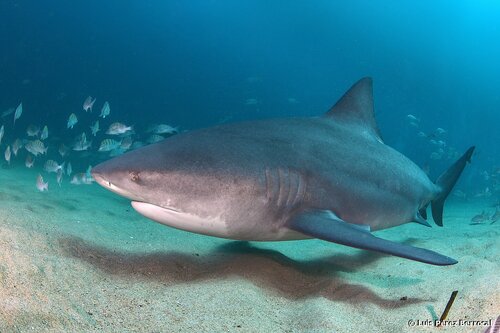
View species detail for Carcharhinus leucas
Bull Shark (Carcharhinus leucas)

Bull Shark

Carcharhinus leucas details → Carcharhinidae
1 iNat observation Apex predator — low but real risk

The one shark worth knowing about here. Bull sharks tolerate fresh and brackish water and push into river mouths and estuaries — including the Río Petatlán lagoon mouth — which is what brings them into the same nearshore, murky water that surfers and swimmers use. Stocky, blunt-snouted, and highly adaptable. Documented in the study area but rarely seen; encounters are uncommon.

The risk is low but not zero, and it is situational. Bull sharks feed most actively at dawn and dusk in turbid water, especially near river outflow after rain when runoff carries bait and lowers visibility. Those are the conditions to avoid — not the fish in general.

Practical steps: avoid dawn/dusk sessions in murky water near the lagoon mouth, especially after heavy rain; don't surf near fishing activity or bait; remove shiny jewelry. Shark incidents on this stretch of coast are not a documented pattern — this is standard caution, not a warning of frequent encounters.

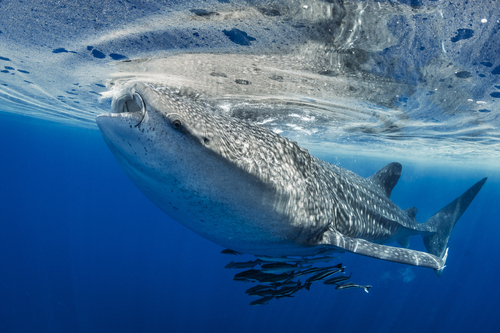
View species detail for Rhincodon typus
Whale Shark (Rhincodon typus) filter feeding

Whale Shark (harmless)

Rhincodon typus details → Rhincodontidae
2 iNat observations Harmless — the encounter of the trip

The largest fish in the ocean — a filter-feeding gentle giant that passes seasonally through offshore waters off this coast. Spotted-blue, slow, and utterly harmless: no threat to swimmers, no teeth to fear. Documented twice in the study area. If you get one, it is the encounter of the trip.

IUCN Endangered. Under Mexican regulations, keep a respectful distance, do not touch, and never block its path — passive observation only. Report sightings to iNaturalist; each one helps map their movement along the Guerrero coast.

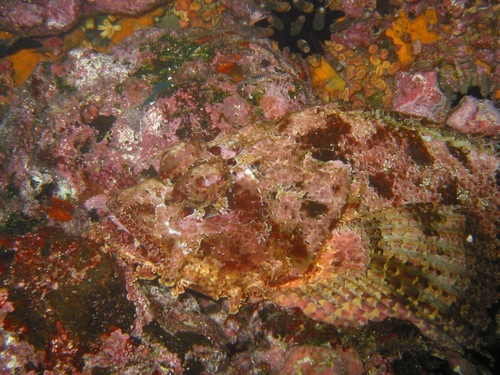
View species detail for Scorpaena mystes
Stone Scorpionfish (Scorpaena mystes) camouflaged on rock

Stone Scorpionfish

Scorpaena mystes details → Scorpaenidae
3 iNat observations Venomous spines — reef hazard

The one genuinely dangerous fish on the Saladita rocks — the "rock fish" everyone means when they warn you. A master of camouflage, it sits motionless on rock and rubble at the headland, mottled brown and impossible to see until it moves. It does not flee; it holds position and relies on being stepped on or grabbed. The 12 dorsal spines, plus anal and pelvic spines, each deliver venom through a groove.

The risk is the rocks, not the water column. Stings happen to people walking or scrambling barefoot on the headland reef, reaching into crevices, or handling one caught in a net or on a line. Watch where you put hands and bare feet on the rocks; wear reef booties on the point. It will not chase or approach you.

If stung: soak the wound in the hottest water you can tolerate (about 45°C) for 30–90 minutes — the venom is protein-based and heat denatures it. Remove any spine fragments. Pain is intense; swelling can spread up the limb. Seek medical care — especially for stings to the hand, for children, or if systemic symptoms appear. Rarely life-threatening to healthy adults but far more painful than a stingray. Local names: rascacio, pez escorpión, lapón.

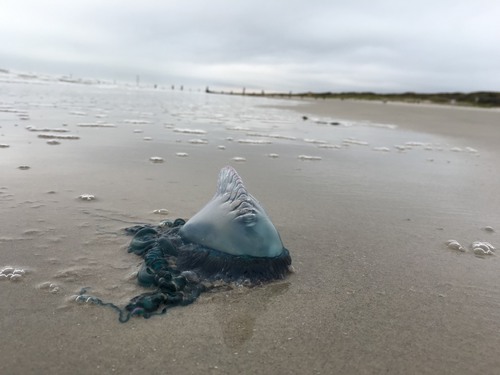
View species detail for Physalia utriculus
Pacific Man-of-War / Bluebottle (Physalia utriculus) floating with blue tentacle

Pacific Man-of-War (Bluebottle)

Physalia utriculus details → Physaliidae — not a fish, but encountered in the lineup
Observed at Saladita Jun 13 2026 Sting risk

Not a fish — a colonial siphonophore that acts like a jellyfish. The Pacific bluebottle is smaller than the Atlantic Portuguese man-of-war, with a single long blue tentacle (rather than many) trailing up to 10 m below the float. Blown onshore by light winds; when they appear, they often appear in numbers. Observed floating in the lineup at Saladita on June 13, 2026.

The sting is sharp and immediate — a burning welt that can last hours. Tentacle fragments on the beach remain potent after the animal is dead.

Treatment: Remove visible tentacle fragments with a card or stick (not bare fingers). Rinse with seawater or saline — not freshwater (freshwater triggers discharge of unfired nematocysts). Apply heat — hot water or a hot pack (45°C) for 20 minutes; heat denatures the venom proteins. Ice provides some pain relief but does not neutralize venom. Antihistamines help secondary itching. Seek care if sting covers a large area, involves the face, or causes systemic symptoms.

Documented

Most-observed species
in iNaturalist.

These are the species most frequently photographed and uploaded within 50 km of La Saladita. They are disproportionately headland-reef species — that's where the divers are. Open-coast and estuarine species are under-represented regardless of actual abundance.

Counts sourced from the iNaturalist species_counts API, taxon_id 47178, radius 50 km, as of 2026-06-09. Live counts may differ.

Field guide

Species by habitat zone.

Cards are common-name-first. IUCN status shown where available. "Regional knowledge" = credibly present by biogeographic range; not yet in a public database for this study area.

Rocky point, boulder reef, and ledges at 2–15 m depth. This is the best-documented zone: most iNaturalist records come from snorkelers and divers along the Saladita headland and nearby rocky coast. Dominance of damselfishes, puffers, wrasses, and moray eels is consistent with shallow Eastern Pacific reef systems broadly.

Sandy beach shore break, adjacent rocky points, and the surf zone itself. Anglers fish this stretch daily from shore and panga — but fishing data rarely enters public databases. Species list here is the most incomplete of the three habitats relative to actual fish density.

Río Petatlán estuary and Laguna de Mitla (~10–15 km southeast). Mangrove margins, brackish channels, tidal flats. Black Snook and Fat Snook are the target species for estuary anglers. Introduced tilapia is established in freshwater reaches. Most species here are from FishBase regional records — almost none have been submitted to iNaturalist for this specific water body.

Open-water pelagic beyond the shelf. Accessible by panga from Petatlán town waterfront. Season peaks Jun–Nov for dorado and yellowfin. Local pangas run 20–40 km offshore for tuna. Saladita-area iNaturalist observations for offshore species are occasional — a few dorado and tuna photos from fishing trips.

Live data

Recent observations — iNaturalist.

Most recent fish observations uploaded to iNaturalist within 50 km of La Saladita. Low frequency is expected — this area is not a high-effort observation zone. Each card links to the original iNaturalist record.

Loading from iNaturalist…

Fetched live from iNaturalist API (taxon_id 47178, radius 50 km). Records include both Research Grade and Needs ID quality. Not all records are from Saladita beach specifically — the 50 km radius captures the broader Guerrero coast.

Citizen science

How to contribute to the record.

The fish catalog here will only improve if people start uploading observations. Snorkelers, spearfishers, surfers who watch the lineup, and anyone fishing the estuary can contribute meaningfully.

iNaturalist — Seek App

Photograph any fish and upload via iNaturalist. The Seek app identifies species from photos in real time without needing a cell signal. Research Grade = two agreeing IDs. Even Needs ID records add location data.

Seek app →

iNaturalist Project

Tag your observations with the La Saladita area when submitting. You can also search iNaturalist for nearby observations and add identifications to help move records to Research Grade.

View existing fish obs →

Fishing records

If you fish the estuary or offshore pangas, a photo of your catch uploaded to iNaturalist with GPS location adds real data to a gap. Dorado, roosterfish, snook, and snapper are all documentable this way. You don't need to release the fish to take a photo first.

Actinopterygii on iNat →
Catch data — what the fishermen know

The fishing village context —
what's actually caught.

La Saladita sits in the Petatlán municipality of Guerrero — a working fishing coast. Local pangas run daily from the beach and the Petatlán town waterfront. What they bring back is almost entirely absent from iNaturalist and GBIF. Federal fisheries statistics fill this gap at the state level.

Game fish and offshore pelagics are ~100% missing from iNat and GBIF because anglers and commercial fishermen don't upload. Roosterfish, sailfish, dorado, and yellowfin tuna are actively caught off this coast but have near-zero citizen-science records for this area. Federal catch statistics (CONAPESCA) fill this gap at the state level. Port-level data for Petatlán specifically is harder to find and requires direct fieldwork.

Guerrero state catch — the numbers.

8,552 tonnes live weight Guerrero state total, 2021
MXN $319M commercial value 2021 (USD ~$17M at 2021 rates)
14th national rank by volume + value, 2021
>90% artisanal fleet state fleet almost entirely small-boat

Guerrero ranked 14th nationally in 2021 with 8,552 tonnes of live-weight production. A 2014 peak of 14,855 tonnes (MXN $345M) reflects both higher effort and the period before COVID disruptions. The state fleet is almost entirely artisanal — no industrial trawl fleet is based here. Small-boat pangas (pangas ribereñas) dominate every landing site from Acapulco to La Unión.

Data year: 2021. Source: CONAPESCA Anuario Estadístico de Acuacultura y Pesca (annual federal fisheries report), cited via Secretaría de Agricultura, Ganadería, Pesca y Desarrollo Rural de Guerrero (campoguerrero.gob.mx, 2023). 2022–2023 totals are in CONAPESCA PDF annuarios — not yet extracted from scanned tables in this build.

Top species by volume — Guerrero coast.

Ranking confirmed from IMIPAS "La pesca ribereña de Guerrero" (2017) and Secretaría de Agricultura Guerrero state fisheries reports. Exact per-species tonnes require manual extraction from CONAPESCA table PDFs — flagged as not yet available. Year of data: 2017–2021.

Mojarra

Gerres spp. / Diapterus spp. (marine); Oreochromis spp. (freshwater "tilapia/mojarra") Gerreidae / Cichlidae
Rank 1 by volume Federal catch data

Consistently the highest-volume species in Guerrero fisheries. Mexican statistics group marine mojarra (yellowfin mojarra, Gerres simillimus; Peruvian mojarra, Diapterus peruvianus) with freshwater tilapia under the "mojarra" category. Guerrero ranks 3rd nationally in freshwater mojarra/tilapia production. Present in the Río Petatlán estuary and nearshore beach seine fisheries.

Source: IMIPAS pesca ribereña de Guerrero (2017); Secretaría de Agricultura Guerrero (2021 data). Exact tonnes in CONAPESCA Anuario — not text-extractable in this build.

View species detail for Scomberomorus sierra

Lisa / mullet

Mugil curema, Mugil cephalus Mugilidae
Rank 2 by volume Federal catch data

Second-highest volume. Mullet is a low-cost high-quantity species taken by beach seine and cast net in estuary mouths, lagoon entrances, and along the beach. The Guerrero coast — mojarra, lisa, and huachinango — is the state's top-three combination consistently cited in CONAPESCA state data. Present in Laguna de Mitla and Río Petatlán estuary year-round.

Source: Secretaría de Agricultura Guerrero (gob.mx); IMIPAS pesca ribereña de Guerrero (2017).

View species detail for Scomberomorus sierra

Huachinango / Pacific red snapper

Lutjanus peru, L. colorado Lutjanidae
Rank 3 by volume / Rank 1 by value 5th nationally Federal catch data

Guerrero ranks 5th nationally in huachinango production — high unit value makes it the state's most economically important single species. Taken on hook-and-line from panga, handline from rocky points, and by longline from cooperative boats. Lutjanus peru dominates the Pacific Mexican south coast; L. colorado also present. The El Cayacal and Japutica landing sites in Petatlán municipality specifically list huachinango as a primary landing species.

Source: CONAPESCA Programa Maestro Estatal Huachinango Guerrero (cadenasproductivas.conapesca.gob.mx); Secretaría de Agricultura Guerrero (2021); IMIPAS 2017 (landing site data).

View species detail for Scomberomorus sierra

Sierra / Pacific Spanish mackerel

Scomberomorus sierra details → Scombridae
Rank 4 by volume Federal catch data

Fast-moving nearshore pelagic. Sierra is an important daily-catch species for artisanal pangas working the open coast. Taken by trolling, cast net near baitfish schools, and handline. Aggregates nearshore Jan–Apr during cooler upwelling months. Present in the surf zone and accessible from the beach at Saladita — 3 iNaturalist observations confirm its presence in the 50 km study area, making it the only top-5 commercial species with even minimal citizen-science documentation locally.

Source: IMIPAS pesca ribereña de Guerrero (2017); Fischer et al. (1995) FAO Eastern Central Pacific Species Guide; 3 iNat observations for this study area.

View species detail for Panulirus gracilis

Cazón / small shark spp.

Mustelus lunulatus, Carcharhinus spp., Sphyrna tiburo Carcharhinidae / Triakidae / Sphyrnidae
Rank 5 by volume Federal catch data

"Cazón" in Mexican fisheries statistics groups multiple small shark species — smooth-hound (Mustelus), small whaler sharks (Carcharhinus), and bonnethead (Sphyrna tiburo). Sold as "cazón en tiras" (shark strips) — a staple of coastal seafood markets. Taken by longline, net, and handline from panga. Mentioned alongside lisa, jurel, pargo, and pez vela in accounts of Guerrero coastal fishers' daily catch composition.

Source: IMIPAS pesca ribereña de Guerrero (2017); Secretaría de Agricultura Guerrero fisheries press releases.

View species detail for Panulirus gracilis

Langosta / Pacific spiny lobster

Panulirus gracilis details → Palinuridae
High value — rank 2 by value 5th nationally — >300 t Federal catch data

Guerrero ranks 5th nationally in spiny lobster production with over 300 tonnes (2021 data). High unit value makes lobster a major revenue driver despite modest volume. Diving cooperatives harvest from rocky reef habitats — the same headland reef environment documented by iNaturalist snorkelers at Saladita. Season is regulated, typically October–February. Barra de Potosí and El Cayacal (Petatlán municipality) explicitly list lobster in their landing-species rosters.

Source: Secretaría de Agricultura Guerrero (gob.mx, 2021 data: "estamos en quinto lugar a nivel nacional con más de 300 toneladas de langosta"); IMIPAS pesca ribereña de Guerrero (2017).

Pacific Mexico pelagics — IATTC context.

IATTC data covers the full Eastern Pacific Ocean — no Guerrero-specific breakdown. These are EPO-wide numbers that provide the regional context for what is seasonally accessible by panga from Petatlán.

299K tonnes yellowfin tuna Eastern Pacific, 2023
292K tonnes yellowfin tuna Eastern Pacific, 2022
Jun–Nov dorado peak season Guerrero coast

Yellowfin tuna runs 19–20% above its 5–10 year average in 2022–2023, meaning the Guerrero offshore zone is seeing above-average tuna presence. Dorado (Coryphaena hippurus) and Pacific sailfish (Istiophorus platypterus) are important EPO fisheries that interact with the tuna fleet. Local pangas run 20–40 km offshore from Petatlán town waterfront for tuna and dorado during the June–November season. Wahoo and striped marlin are occasional offshore targets.

Billfish note: Recreational catches of sailfish and marlin are substantially less than commercial interaction but are widely released — sport fishing data for Ixtapa-Zihuatanejo confirms year-round presence with peak Jun–Nov. These are entirely absent from CONAPESCA data (recreational catch is not reported) and from iNaturalist (anglers don't upload).

Source: IATTC Report No.22-2024 "The Tuna Fishery in the Eastern Pacific Ocean in 2023" (iattc.org); IATTC Report No.21-2023 (2022 data).

Petatlán–Zihuatanejo corridor — the local fleet.

The IMIPAS "La pesca ribereña de Guerrero" study (Instituto Mexicano de Investigación en Pesca y Acuacultura Sustentables, 2017) documented landing sites along the full Guerrero coast. In the Petatlán municipality specifically:

3 landing sites Petatlán municipality
~32 documented pangas Barra de Potosí (25) + La Barrita (2) + El Cayacal (5)
3 landing sites in Zihuatanejo Playa Linda, Las Salinas, Playa Principal

The three Petatlán landing sites document a multispecific artisanal fishery: huachinango, pargo, jurel, croaker, octopus, and lobster. Barra de Potosí — a well-known lagoon 5 km southeast of Saladita — operates 25 pangas from one cooperative plus two individual permit holders. INAPESCA began a logbook program in Zihuatanejo and La Unión (~2018) to start measuring catch-per-unit-effort for the first time; prior to that, no systematic CPUE data existed for the Guerrero artisanal fleet.

Source: IMIPAS "La pesca ribereña de Guerrero" (imipas.gob.mx PDF, 2017). Landing-site counts as of survey date.

What the data still can't tell you.

Structural gaps in fisheries data for this region:
  • Most CONAPESCA data is state-level. Port-level data for Petatlán specifically is not publicly disaggregated in federal annual tables.
  • Small-scale (artisanal) fisheries are structurally undercounted in Mexico. Sea Around Us (Cisneros-Montemayor et al. 2015, UBC) estimates unreported catch at 20–40% above official CONAPESCA figures nationally. Pangas landing on beach rather than registered docks, self-reporting with weak enforcement.
  • Sport fishing and recreational angling — roosterfish, dorado, sailfish, marlin from Ixtapa-Zihuatanejo charter pangas — contribute zero to CONAPESCA statistics and zero to iNaturalist. The most-sought game fish are completely invisible to federal data systems.
  • IATTC data covers the full Eastern Pacific. No Guerrero state or Petatlán port breakdown is disaggregated.
  • CPUE trend data for Guerrero artisanal fleet began only ~2018 (INAPESCA logbook program). Trend analysis not yet publicly available in aggregate form.

See /conservation/ for fishery sustainability and bycatch context — including sea turtle interactions in Pacific Mexico gillnet fisheries. See /turtles/ for bycatch overlap between Hawaii longline fisheries and Mexican Pacific gillnet operations where olive ridley and leatherback overlap with commercial fishing zones off this coast.

Methodology & sources

Where this data comes from.

iNaturalist

Species counts fetched from the iNaturalist API (observations/species_counts) for taxon_id 47178 (class Actinopterygii), 50 km radius centered on La Saladita (lat 17.5897°N, lon -101.4317°W). 1,436 total observations, 180 species-level taxa, as of 2026-06-09. Live recent observations fetched from observations endpoint sorted by observed_on desc. iNaturalist API documentation.

GBIF

Queried GBIF occurrence search API (taxonKey 204, class Actinopterygii) for bounding box lat 17.36–17.82, lon -101.68–-101.18. Returned 0 records on the 2026-06-09 build. The comma-range filter for decimalLatitude/decimalLongitude did not match records in this dataset. iNaturalist is the sole documented database source for this area. GBIF Occurrence API.

FishBase

Taxonomic and ecological data (habitat, depth range, max length, distribution) for catalogued species sourced from FishBase (Froese & Pauly, Eds., FishBase. World Wide Web electronic publication, www.fishbase.org). IUCN Red List status pulled from FishBase species pages (which mirror IUCN Red List assessments). FishBase REST API at fishbase.ropensci.org returned 404 during this build; status confirmed via FishBase.se species pages.

WoRMS

World Register of Marine Species used for taxonomic cross-reference and family-level classification of marine species. marinespecies.org. Estuarine and freshwater species not indexed in WoRMS sourced from FishBase and Catalog of Fishes (Eschmeyer et al.).

Regional knowledge

Species marked "Regional knowledge" are documented in peer-reviewed literature and field guides as present in the Mexican Pacific coastal zone (specifically the Guerrero–Michoacán corridor) but are not represented in the iNaturalist or GBIF study-area datasets as of this build. Sources: Castro-Aguirre et al. (1999) Ictiofauna Estuarino-Lagunar y Vicaria de México; Fischer et al. (1995) FAO Species Identification Guide for Fishery Purposes: Eastern Central Pacific (FAO); Robertson & Allen (2015) Shorefishes of the Tropical Eastern Pacific Online (STRI, Smithsonian).

CONAPESCA (federal fisheries statistics)

Annual Anuario Estadístico de Acuacultura y Pesca published by CONAPESCA (Comisión Nacional de Acuacultura y Pesca). State-by-species catch tables; Guerrero rows used for state totals. 2021 figure (8,552 t live weight, MXN $319,682,463) cited via Secretaría de Agricultura, Ganadería, Pesca y Desarrollo Rural de Guerrero (campoguerrero.gob.mx, 2023). 2022–2023 figures are in CONAPESCA PDFs available at nube.conapesca.gob.mx — tables are scanned images in older editions and require manual extraction; not yet automated. Species-level rankings and national-rank positions from CONAPESCA Programa Maestro Estatal Huachinango Guerrero (cadenasproductivas.conapesca.gob.mx).

IMIPAS — La pesca ribereña de Guerrero

Instituto Mexicano de Investigación en Pesca y Acuacultura Sustentables (formerly INAPESCA). "La pesca ribereña de Guerrero" — comprehensive landing-site survey of the Guerrero coast including cooperative counts, vessel counts, and species-by-landing-site data for Petatlán municipality (Barra de Potosí, La Barrita, El Cayacal). Published ~2017. Available at imipas.gob.mx and mirrored at gob.mx. ResearchGate: Aragón-Noriega et al. (doi:10.13140/RG.2.2.35905.89449). PDF cached locally.

IATTC (Eastern Pacific tuna + billfish)

Inter-American Tropical Tuna Commission annual reports. Yellowfin tuna EPO 2022: 292,000 t; 2023: 299,000 t (19–20% above prior-period averages). Source: IATTC Report No.21-2023 (2022 data) and No.22-2024 (2023 data). iattc.org. Data covers full Eastern Pacific — no Guerrero state disaggregation available.

Sea Around Us — unreported catch reconstruction

Cisneros-Montemayor AM, Cisneros-Mata MA, Harper S, Pauly D (2015). "Unreported marine fisheries catch in Mexico, 1950–2010." Fisheries Centre Working Paper #2015-22, University of British Columbia. seaaroundus.org. Basis for 20–40% undercount estimate applied to Guerrero artisanal fisheries context.

Build artifacts

Climatology artifact: functions/api/_fish_climatology.js
Fisheries catch artifact: functions/api/_mx_fisheries_catch.js (26 KB; CONAPESCA + IMIPAS + IATTC data)
Rebuild scripts: scripts/build_fish_climatology.py and scripts/build_mx_fisheries_catch.py (stdlib-only, hard exit, /tmp cache)
API endpoint: /api/fish (Cloudflare Pages Function)